
1. Broader Coverage and Modernized Structure
The 2025 Order expands coverage from 13 to 16 sectors and from 25 to 46 subsectors, aligning with the diversification of Tanzania’s economy.
Notably:
- Existing sectors have been redefined for greater clarity. For instance, Domestic and Hospitality Services have been separated into Domestic Work and Hotel and Hospitality Services; Transport has evolved into Transport and Shipping; and Trade and Industry has been split into Trade and Finance and Industrial sectors.
- The Fishing and Marine sector is now merged with Agriculture under Fishing and Fish Farming (Aquaculture).
- New sectors have been added, including Sports, Arts, Entertainment and Gaming Activities, and Waste Collection, Processing and Disposal.
This restructuring ensures more precise categorization of employees and fairer wage benchmarking across industries.
2. Adjusted Minimum Wages Across All Sectors
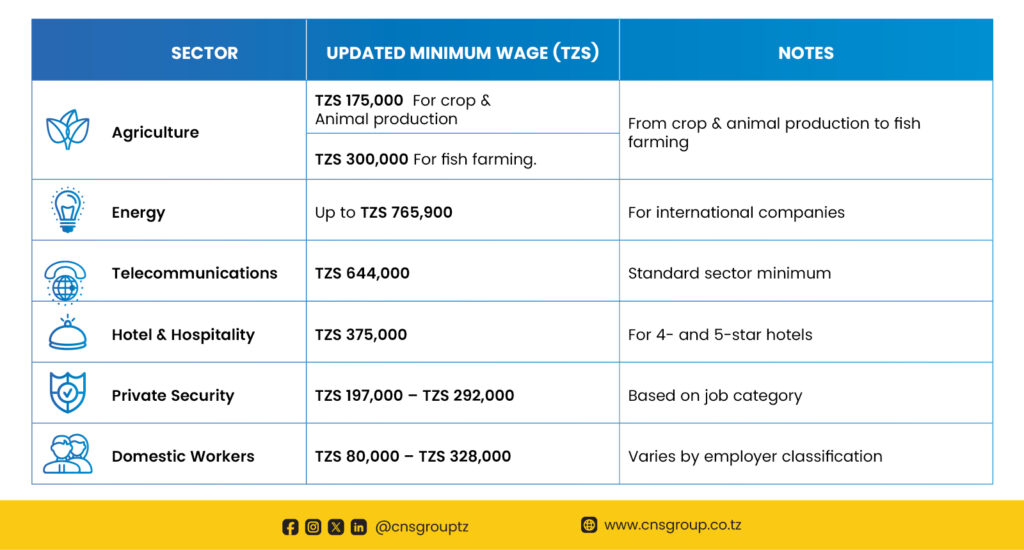
The Order introduces new minimum monthly wage rates across all 16 sectors. Examples include:
- Agriculture: From TZS 175,000 for crop and animal production to TZS 300,000 for fish farming.
- Energy – Up to TZS 765,900 for international companies.
- Telecommunications – TZS 644,000 minimum wage.
- Hotel and Hospitality – TZS 375,000 for four- and five-star hotels.
- Private Security – Ranging from TZS 197,000 to TZS 292,000.
- Domestic Workers – From TZS 80,000 to TZS 328,000, depending on employer classification.
Employers are encouraged to review their payroll structures to ensure compliance by 1st January 2026.
3. New Employment Standards for Worker Welfare
Beyond wages, the 2025 Order introduces enhanced employment standards aimed at promoting employee well-being and productivity. These include:
- Leave travel assistance for employees every two years of continuous service.
- Subsistence allowances for employees required to work outside their usual workstations.
- Special allowances for truck drivers to cover mileage, loading/unloading, and long stays away from home.
These provisions not only align with international labour standards but also strengthen Tanzania’s commitment to decent work conditions under the ILO Decent Work Agenda.
4. Protection for Employees with Better Terms
Employees currently earning above the new minimum thresholds or enjoying better employment conditions will retain their existing benefits. The Order explicitly ensures that the new minimums serve as a floor, not a ceiling — reaffirming employers’ flexibility to negotiate higher wages through contracts or collective bargaining agreements.
5. What This Means for Employers
- Employers across all sectors must:
Review and align salary structures before the effective date. - Update employment contracts and HR policies to reflect the new wage provisions.
- Engage in dialogue with employees, unions, and industry associations to manage expectations and transitions.
- Budget and forecast for increased payroll costs, especially in sectors where adjustments are significant.
6. A Step Forward for Inclusive Growth
The 2025 Minimum Wage Order represents a deliberate policy shift to balance economic growth, social protection, and fair compensation. For employees, it signals recognition of their contribution to national productivity. For employers, it calls for stronger workforce planning and sustainable business practices.
At CNS Group, we view this as an opportunity for organizations to rethink compensation strategies, enhance compliance, and build more motivated workforces. By aligning HR policies with these new standards, employers can strengthen retention, attract talent, and foster industrial harmony.
In Summary
The Labour Institutions (Minimum Wage for Private Sector) Order, 2025 is more than a wage adjustment — it’s a structural reform towards inclusive, equitable employment in Tanzania. Compliance isn’t just a legal requirement; it’s a strategic imperative for every responsible employer committed to decent work and sustainable growth.
For advisory support, payroll alignment, or compliance audits on the new Minimum Wage Order 2025, contact us via our email(s) – info@cnsgroup.co.tz or +255 742 772 000.
Disclaimer: This article has been prepared by CNS Group for general informational purposes only and as part of our commitment to sharing knowledge on evolving HR and labour developments in Tanzania. It is intended to promote understanding and dialogue. It does not constitute legal, financial, or professional advice. Readers are encouraged to seek specific guidance from qualified professionals or relevant authorities before making decisions based on the information herein.